
In today’s global economic landscape, US Corporate Bonds Investment Trends 2026 have reached a critical juncture. According to a recent Citigroup report, international investor interest is rapidly shifting from the legacy banking sector to Silicon Valley’s Big Tech companies. To understand US Corporate Bonds Investment Trends 2026 in depth, we need to look at how foreign capital is now supporting ‘Artificial Intelligence’ and ‘Digital Infrastructure’ rather than financial institutions. US Corporate Bonds Investment Trends 2026 has become a hot topic of discussion among global portfolio managers because this year a very interesting balance is being seen between bond yield and sector-rotation.

Bond Market Battle: Why is money flowing from banks into tech?
Citigroup’s report has sparked a new debate in the market. Data clearly shows that foreign investors are reducing their exposure to US bank bonds and moving toward long-duration bonds of technology companies. This change is not sudden; rather, there are some solid fundamental reasons behind it.
The Crown is Moving: Financial Giants Dethroned as Capital Floods the TMT Sector!
Historically, the US financial sector (such as JP Morgan, Goldman Sachs) was considered the king of the bond market. But US Corporate Bonds Investment Trends 2026 clearly show that the banking sector’s share, which used to be 53.8% earlier, has now declined to around 39%. In contrast, there has been a tremendous surge in demand for the Technology, Media, and Telecom (TMT) sector.
Why is ‘Tech’ the new ‘Safe Haven’ for foreign investors?
These days, the balance sheets of large tech companies are so strong that they rival the GDP of many countries. Foreign investors, especially from Asia and Europe, are now viewing tech bonds as ‘digital gold.’
1. The Boom of AI Infrastructure
Riding on the AI revolution, tech giants have taken the bond market by storm. These companies are raising capital to meet the growing demand for data centers and AI chips. These bonds have become a safe and high-growth investment option for foreign investors.
2. Robust Free Cash Flow (FCF)
Most tech giants have large cash reserves. This is a major factor under US Corporate Bonds Investment Trends 2026. It is less risky for investors to lend to companies that have strong debt repayment capacity, while banks are often pressured by high-interest rates and strict regulations.
3. Yield Resilience
US corporate bonds are offering idiosyncratic returns today for investors seeking higher yields than ordinary treasury bills. The increase in demand for bonds with maturities longer than 15 years reflects the market’s long-term confidence.

Geopolitical Catalysts: Who is Buying These Bonds?
The list of countries affecting US Corporate Bonds Investment Trends 2026 this year is quite interesting:
Hong Kong & Japan: The most money is flowing from here. Hong Kong investors have increased their stake in US bonds by approximately 19%.
The Nordic Countries: Sovereign wealth funds in countries like Norway are now aggressively changing their investment strategies.
Middle East: Countries like Kuwait and the UAE are parking energy profits in US tech bonds to diversify their portfolios.
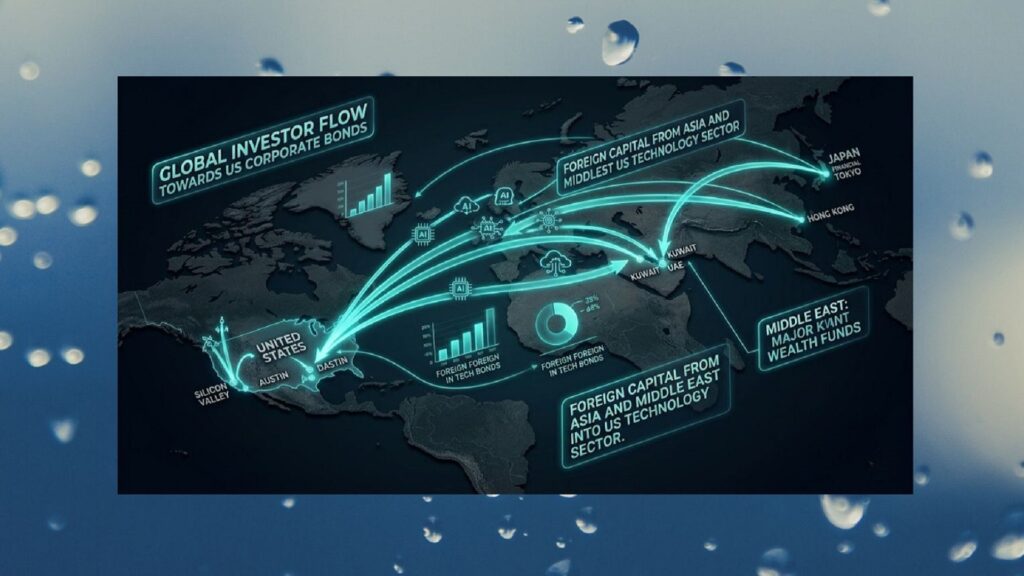
The Plateau Effect of FOMC: Pressure on Banks, Tech Bonds Become Investors ‘Safe Haven’.
The US Federal Reserve’s (Fed) interest rate policies have a direct impact on US Corporate Bonds Investment Trends 2026. Although rates have now reached a plateau (stable level), inflation is still not completely under control.
When interest rates are high, pressure increases on banks’ profitability as their net interest margins shrink. Meanwhile, tech companies handle this pressure better due to their innovative power. This is why foreign investors now consider tech bonds more robust for regular income.
The Growing Role of Private Credit
Another significant factor driving this year’s trends is the rise of private credit. Many smaller banks are reducing their lending, allowing larger companies to raise funds directly from the bond market. This represents a paradigm shift for foreign investors. Instead of investing through banks, they are now lending directly to companies that control global supply chains.
The Death of Junk Bonds? Why Quality is King in the New Tech Era.If you’re a US-based investor, the US Corporate Bonds Investment Trends 2026 offers some clear signals:
Sector Diversification: Don’t rely solely on government treasury. Corporate bonds, especially in the tech sector, are outperforming in terms of risk-adjusted returns.
Watch the Duration: Foreign investment in long-term bonds (15+ years) is increasing, indicating that the market expects stability in the long term.
Credit Quality Over Yield: Don’t be lured into ‘junk bonds’ by high yields. ‘A-rated’ bonds in the tech sector are currently in their best position.

Citigroup’s Prediction: The Transparency Test That Could Make or Break US Banks.
As we move into the second half of 2026, US Corporate Bonds Investment Trends 2026 are becoming clearer. As long as disruptive technologies like AI and cloud computing reign supreme, demand for tech bonds is expected to remain steady.
Citigroup experts believe that banks will need to increase transparency in their balance sheets to regain investor confidence. For now, the dollar’s strength and US tech leadership have made US Corporate Bonds Investment Trends 2026 completely tech-heavy.
The Final Verdict: Why Technology is the New Backbone of the US Bond Market.
The conclusion is that US Corporate Bonds Investment Trends 2026 are making it clear that ‘Smart Money’ is now moving away from banks and toward innovation. This trust of foreign investors is a testament to the resilience of the US economy and its technological supremacy. Whether you are a large institutional investor or a small retail trader, ignoring these trends could prove suboptimal for your portfolio. In the coming months, the direction of US Corporate Bonds Investment Trends 2026 will depend on the US elections and the stance of the Federal Reserve. But one thing is certain: Technology is no longer just a sector, but has become the new ‘backbone’ of the bond market.
DISCLAIMER: This blog is for informational and educational purposes only. The trends and analysis shared here are based on market reports. Investing in the bond market or any financial instrument involves market risk. Consult your financial advisor before making any major investment.